







What’s the biggest news story of the moment?
The kidnapping of Nancy Guthrie?
The LDP’s sweeping victory in last weekend’s Lower House elections in Japan?
The drought in Kenya?
Yes, depending on what part of the world you happen to reside in, one of these stories (or the local equivalent) will be dominating the headlines when you scroll through the newsfeed today.
But 100 years from now, what news from our era do you think your great-great-grandchildren will be reading about?
Do you think they’ll be learning about the Epstein files?
Do you think they’ll be preoccupied with the geoeconomic scramble for rare earths that presaged WWIII?
Do you think they’ll be scrutinizing New World Next Week Episode #619, in which James and James cover the Bezos ring camera surveillance fiasco?
Actually, that’s a trick question. Given the way birth rates are plummeting throughout the world, it’s quite likely you won’t even have great-great-grandchildren running around 100 years from now.
And, even if you beat the odds and actually do have progeny walking the earth a century hence, they’ll no doubt be more interested in the stories that we’re ignoring right now:
New York State Is Headed for a Decade of Population Decline
and
Congressional Budget Office Projects Lower Than Expected US Population Growth
and
Japan nears 10% foreign population years ahead of official forecasts
and
Iran’s Youth Population Shrinks as Demographic Window Rapidly Closes
and
France sends letters to 29-year-olds telling them to get on with having children
and a thousand similar stories that we hardly notice today.
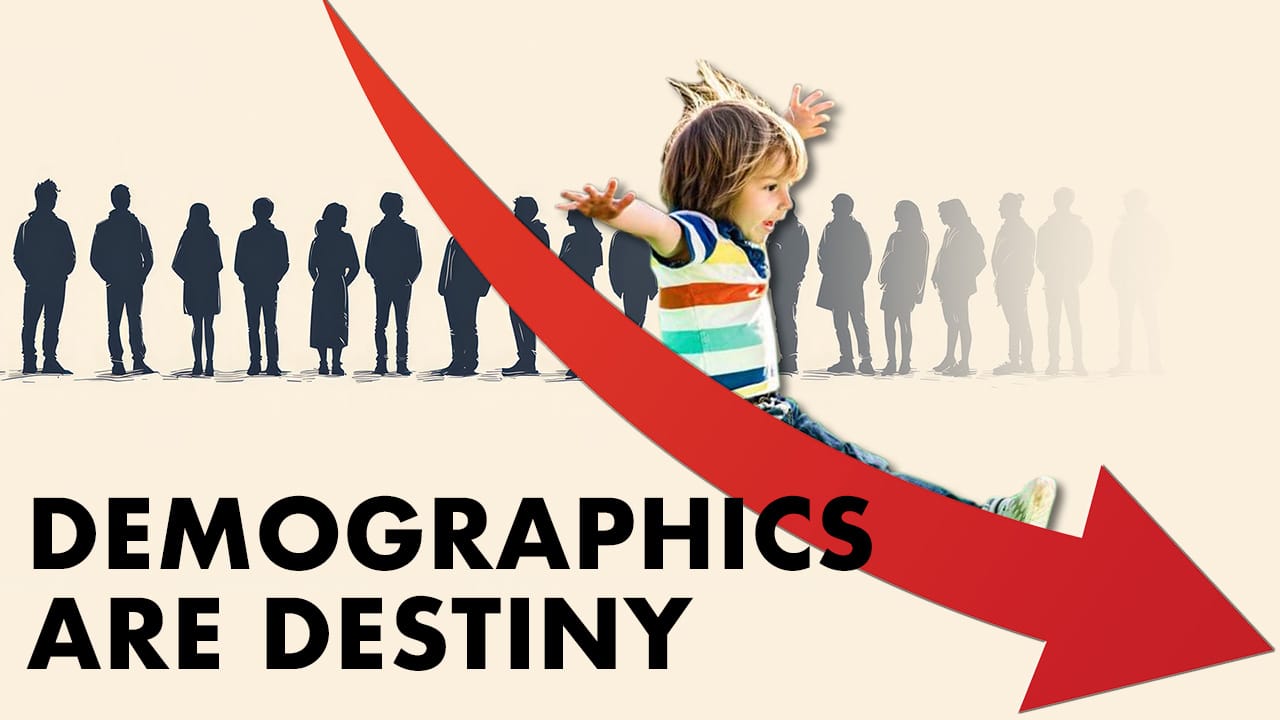
In case you didn’t notice, we’ve already begun the descent into a shrinking world, and it’s already tearing the fabric of society apart at its seams. Indeed, the demographic crunch is perhaps the most consequential story in the history of humanity, and yet it’s scarcely ever talked about.
So today, let’s dive straight into the heart of the matter and see if we can answer two questions: how does population collapse lead to the collapse of civilization, and is there any way to avoid this demographic destiny?

Contraception is humans trying to control nature and it’ll always come back and bite you on the arse , when you try and control nature. This one thing has changed us more than anything methinks.
Hey andy.b,
If we don’t control some aspects of nature, nature will kill us all.
I’m not here to attack you, but I do want to share some opinions.
Women have always practiced some form or contraception throughout time. Contraception is not the problem. (Women in the 1800s had a 1-in-8 chance of dying from pregnancy and or childbirth before modern medicine developed ways to prevent a lot of deaths. Pregnancy and childbirth was THE riskiest thing a woman could do with her body. Why do you think the Victorians didn’t want women riding bicycles? Women died all the time.)
It’s the systems that have developed over the last century that were designed with Eugenics in mind, that has made it really difficult to have a family (at least in the United States) even couples who want children have all these obstacles placed before them that make children a liability, and source of shame from employers and corporations. Corporate America hates children. It hates families.
(It hates people, in general, and it’s really hard to be alive in America.)
Men (in America) also need to shift their attitude toward women. I feel (as an American woman) that (American) men don’t necessarily respect me as a human person, based solely on the fact that I am a woman.
This issue of population decline goes way deeper than just access to contraception, for women. I mean, at least we (women) can control that. Because most of the childcare (in America) falls on the shoulders of women. Men have the option of just walking away, and a lot of them do. (A lot of men do not pay child support.) Until all these systems change in a way that better supports women in a choice of motherhood, we’re probably going to continue to see a slide in population.
Bird
Contraception in the past was unreliable – thus having sex outside of a pairing brought big economic risks to the woman, who were thus generally much more uptight about dishing out sex. There was even a risk that a man having sex outside of marriage would be forced to marry a woman he impregnated.
The advent of reliable Hormonal birth control basically destroyed the ‘price’ of sex and devalued woman (since they were now much more available for recreational sex without commitment) and allowed for the anti-family changes in the economy (desired by the ruling class for a long time) to take place. Sure “some” people always played out of bounds, but it was risky enough that it was not the norm as we saw develop with Boomers, which led to teh collapse of relationship dynamics we see in so many zoomers
I recall, as a kinda related fact, reading in Freeakanomics that the price of acquiring sex via prostitution had dropped to an all time low in modern (post sexual revolution ) times.
Duck,
“The advent of reliable Hormonal birth control basically destroyed the ‘price’ of sex and devalued woman (since they were now much more available for recreational sex without commitment)”
– I think a better word might be ‘cost,’ but I’m splitting hairs.
I don’t think it actually “devalued” women (at least for themselves), it did shift the power dynamics a bit.
Maybe men of the era wanted to view women who used contraception as “less than” other women who didn’t.
If we can pause seeing contraception through the lens of Eugenics and the politics of Planned Parenthood, there are upsides when women have access to control over their own fertility.
If women have access to contraception, they can explore their own sexuality, without some of the risks involved in unprotected sex.
Access to contraception prevents abortion.
Before there were safe and legal abortion services – women still had abortions. (Coat hanger abortions on kitchen tables without anesthesia or antibiotics were a thing, back in the day)
Making contraceptives and abortion illegal doesn’t stop people from having sex, it doesn’t stop unplanned pregnancy. All it does is make things more dangerous for women.
Also, women still get sexually assaulted. Rape is absolutely a thing that happens to women (and to, men, as well. By other men.) 1-in-3 women report being raped, sometime in their lifetime.
Reported.
The percentage is probably higher.
Every woman I know in my personal life has been raped, at least one time.
Before the 1960s, we weren’t having this conversation. All of this was taboo. All of this was “a private family issue,” that people just looked away from. If you saw your neighbor beating his wife, you ignored it. It wasn’t your business. And that woman couldn’t just leave, because the bank wouldn’t allow her to have her own bank account.
Access to contraception is an extremely important issue for women’s rights.
The decision to bring a child into the world should be a conscientious and loving choice.
If there is no access to contraception, the *choice* has been removed.
People, in general, would naturally have more children, if there wasn’t pressure from the system not to.
The pressure applied by governments and corporations to not have children trumps any access to contraception a woman might have, that is contributing to declining birth rates. (In my opinion)
Bird
“…I don’t think it actually “devalued” women (at least for themselves), it did shift the power dynamics a bit.
Maybe men of the era wanted to view women who used contraception as “less than” other women who didn’t….”
NO… men LOVE birth control because it makes sex with women cheaper. Birth control was (for a time) a massive boone to men.
Its pretty clear that, while women (hopefully) enjoy sex teh drive to HAVE it is much more a male thing…. in pre birth control days it served as a lure to get them to settle down and care for a women. That lure went away, and while it ultimately hurt men in the longer term too the first to suffer were women and kids
It devalued women because the main thing they have to interest young men is sex. As with all supply and demand systems this means that when sex is available “for free” (without commitment or responsibility) for the male, the male has much less incentive to value or invest in the female.
I recall it put best by a dude on a BBC doc “why I hate the 60s’ (IIRC) who said something like “The pill made women much freer….which of coruse made them much more available” He had a very pleased grin saying it, no doubt thinking of all the women he had sex with without having to be responsible for.
“…Every woman I know in my personal life has been raped, at least one time….”
WTF kind of people do you know ??
If EVERY one of them has been raped AT LEAST one time then they must be doing some crazy dangerous life style. Are they all sex workers or homeless drug addicts or what?
“…1-in-3 women report being raped, sometime in their lifetime….”
Is that fake meme still a thing?
https://time.com/3393442/cdc-rape-numbers/
Dude, what?
I’m pretty sure that’s how YOU see women.
I’m also pretty sure you don’t know your ass from your elbow about anything having to do with women or women’s issues.
Bird
“…I’m also pretty sure you don’t know your ass from your elbow about anything having to do with women or women’s issues….”
Yes, thats a very convincing argument.
lololololol.
“Womens issues” are a creation of men and maybe the richest 3 or 4 % of women who actually benefited from the changes brought about by the sexual revolution.
But I will be leaving in a bit, so if you post any arguments you may have to wait for a reply
Wow… do you think every woman you meet in your daily life work, family, friends etc… id going to tell you if were raped at some point in their life? Whether it be by a stranger, partner or relative.
Going by your previous comments do you think your wife or daughter would confide in you if they were raped? I’m guessing no.
R
lol, dude, people dont tell me that they were abducted by aliens either…..do you argue they are getting snatched by by the saucer people? The fact people dont tell me about it means it’s real???? Lololll
Sorry, but your logic is kinda faulty here.
If you have anything to bring thats an argument I’d be happy to hear it but mere emotional kvetching doesn’t really interest me.
As to my wife or daughter….What are you even asking? I know they trust me to fix such things and if you don’t know anyone you trust I am sorry that modernity has hurt you in that way
Bird
A pretty interesting book (even if written by a guy who is more catholic then the pope) is Libido Domminandi by EM Jones.
It goes into the history of the sexual revolution, which one can argue is basically a way to turn women into poor quality men, and men into work and consumption focused drones.
I’d like to post a reply the your reply on the above comment.
“Womens issues” are a creation of men and maybe the richest 3 or 4 % of women who actually benefited from the changes brought about by the sexual revolution.“
That comment is most asinine.
Wow.
That is dumb.
Dumbest thing I’ve read today.
It’s also incredibly dismissive, condescending and misogynistic.
Totally disconnected from reality.
Absolutely offensive.
B ird
“…..That comment is most asinine.
Wow.
That is dumb.
Dumbest thing I’ve read today….”
Then show me HOW its WRONG…..???
“…..It’s also incredibly dismissive, condescending….”
Yes, indeed, but since you have yet to make an argument or present true facts to counter my POV I DO dismiss such nonsense ideas.
They are indeed silly ideas, created to further the goals of rich guys.\ and repeated by silly people
“…. and misogynistic….”
hahaha…yesm thats a REAL arument there. lololol
“…Totally disconnected from reality…”
Then present counter facts and counter arguments… or do you mean ‘disconected from the reality that exits in my mind and heart’???
“…Absolutely offensive….”
Thank you.
But be quick if you have counter ARGUMENTS (rather then emotional waffle) since I must be going soon)
Man, there’s centuries worth of history books full of stories about women’s oppression against women.
The fact that women couldn’t have their own bank accounts until the 1970s(?) should be proof enough.
That’s why it was such a tragedy for women to be spinsters. They literally had no rights of their own, and literally needed male representation to move through the world.
Women automatically lost their names in marriage. They became “Mrs.” Some Guy.
Chattel.
Second class citizens. Throughout western history.
Women’s Rights is a legitimate movement.
Feminism happened because it needed to happen.
Helen Reddy wouldn’t have had hit songs if they didn’t resonate with regular women around the world.
You’re just being ignorant on this thread. You’re pretending like you don’t have a clue how it used to be for women.
“And I know too much to go back and pretend.”
Bird
“… The fact that women couldn’t have their own bank accounts until the 1970s(?) should be proof enough.….”
That snippet ougjt to give you something to think about- firstly is having a bank account the sign that you matter as a person in a social frame work or the sign that you matter as an economic unit????
Becoming an autonomous economic unit is exactly what the rich folks pushing “women’s issues” desired….certainly the myth that women were clamoring for the vote (when infact women’s suffrage was NOT popularly desired by the majority of women) is untrue. The stats about women’s happiness DECLINE since the sexual revolution hardly make it look like it benefited most women.
https://www.psychologytoday.com/us/blog/pressure-proof/201303/women-happiness-is-it-still-declining
Quote from article
“…. The study reported several findings:
Women in the United States have become less happy, both absolutely and relative to men;
The decline in women’s happiness is a trend seen across groups – both working and stay-at-home moms, for those married and divorced, the young and old, and across the education spectrum; and
These same trends appeared across industrialized countries for which there are sufficient happiness data….”
You can dig up plenty of other sources for this data if you wish….pretty clearly MOST women have NOT benefited from, though the ruling class has doubled (and halved the cost) if its workforce and a few upper class women now have access to the top jobs.
Iirc women were also immune from bankruptcy courts demanding money from them prior to “equality” and if you look at at the HISTORY of the folks pushing “women’s issues” their pretty much the capitalist owning class, rich women, and Gov spooks.
Bird
Continued
It occurs to me I forgot to make clear the point of referring to the sexual revolution (which was only made possible by the Contraception Revolution) as being bad for women as well as women, and eventually men.
One can judge a system by IF IT SURVIVES….ye olde system of before the Pill survived and bred enough people to continue….the current Post Pill system can not breed enough people to continue.
EVEN if we agreed (and we don’t) that the new system makes women individually happier the fact is the system itself tjat would support that happiness is not able to sustain itself….what Can Not go on Will not go on.
My and your opinion about birth control tech being available freely is interesting but ultimately a system where it is removed from free circulation is inevitable because any society that doesn’t remove it will die and be replaced by one that does limit it.
That’s a very Statist attitude. It’s not Libertarian or Voluntaryist to tell women how or when to have children.
You can’t dictate to women how they can control their bodies or their fertility.
You are in the moral wrong here, sir.
Bird
“…You are in the moral wrong here, sir.…”
Maybe….but I am NOT factually wrong.
1862 (California):
The first state law allowed women to open bank accounts, notes Centra Credit Union.
But they did pass a nationwide law in1974.
1974 (October 28):
The Equal Credit Opportunity Act (ECOA) was signed into law, prohibiting discrimination based on sex or marital status in credit lending.
but that isn’t the central point of your posts, is it?
Please distill your argument for me. What is the main point you are championing vis-a-vis the demographics article?
Because, of course, women *loved* being second class citizens.
The examples you quoted are evidence that it was like a genie granting a wish.
Women wanted the choice.
What society gave them was a bastardized version of what they were asking for.
The government and corporations fixed the system, making it nearly impossible for a family to survive on one income, alone.
We CAN have equal rights for women, giving them a choice to stay home and raise a family or have a career, or do something interesting in life.
The Powers that Should Not Be, gamed it, to punish women.
“You got what you wanted,” they say.
No, we didn’t.
We didn’t ask for *this*
I don’t think you understand the feminist movement, and the sources you quoted sound like propaganda to support some idea that women enjoyed subjugation.
Bird
See my “continued” post above
I never said women “enjoyed” beinh subjugated – I just said that the short term benefits result in long term costs that lead to general unhappiness (esp. for women) and further the post sexual revolution world will revert to a prior form because it is unsustainable.
How I FEEL about that is not relevant. The inevitability of a return to prior sex roles is pretty much a given because it can not sustain itself except for a time by vampiricly sucking population from less developed parts of the world.
It may (I don’t think so) make people happier individually but if it cant maintain itself it’s going away.
Also I really think you should look at Rachel Wilson’s work on the history of feminism and WHO was behind it – there are better takes in it but she has the basis
Bird
Rachel Wilson’s sub stack
https://substack.com/@rwilson
Since just searching her name brought up random stuff
from the rainy clines of somerset.
looking forward to reading the above but first ……
glanced the population growth graph, is it possible that the super elites who lust control and hate people would get a real buzz out of mass killing, do they believe that power could be achieved by death energy release, like a big ritualistic event. ??
jon
Hey I’m in rainy Somerset too! I wonder how many of us subscribers there are around here…
lots i hope, i’m tucked away in the quantocks, could this be the starting of the Somerset chapter?
What concerns me personally about the population reduction program is less that the human race will be extinguished than that evil has gained the upper hand. Control over life and death is something not designed, IMHO, to be in the grip of human hands. The Promethean impulse to acquire this power is destined to end badly for the Prometheans, whose livers are imperiled by their megalomaniacal ambitions. It is my belief, or faith, that there is an ebb and flow in the affairs of humans, and that although we now live in an ebb tide, in the shadows of evil, just as the world turns, light will return and so will the flow of goodness. Like the yin yang symbol, the opposite is always contained in the prevailing trends, and reversal is immanent in whatever pattern dominates. My concern is not that that the pattern will not reverse itself, but that so many people I love and care about will be harmed before the inevitable peripety.
MarkB: I read this as: “What will be, will be. The future’s not ours to see.” And not ours to control, e.g., “inevitable peripety.”
Historians record this, until the beginning of philosophy, i.e., metaphysics, epistemology, ethics, politics, aesthetics. The best example is Aristotle, who invented reason, and its child, science.
didnt aristotle think some men were natural slaves?
https://en.wikipedia.org/wiki/Natural_slavery
According to PharmaTechnology.com, 64% of the global population got the contagious, deadly and sterilizing, C19 injection.
According to the UN World Population Conference of 1994 (Cairo), 8 Billion was the drop dead number for the Global Financial Elites to take action. What actions they proposed, was in Exhibit H (I think), that was removed from the Archive.org .pdf copy of the report from this conference. The UN has failed to respond to my requests for the complete document.
In 2022, we clocked 8 Billion souls on Earth. So the contagious, C19 kill and sterilize shot was right on time. We are now looking at an on-going global democide, who’s architects were striving for an immediate 80% die off rate but failed to achieve it (Elana Freeland, Geoengineered Transhumanism, 2025).
I just finished these two podcasts. Now I understand the “reset” we are experiencing this time. Today’s events are just more machinations by the Global Financial Elites (GFEs).
They have been cycling us through these cascading eventlines for centuries, waiting for the right mix of technology and opportunity – to finally convert us into the cyborg Human 2.0 that they desire, in just the right numbers:
“Youtube is suppressing this one after 7 days… and it really is fascinating. The photos… what would it be like to work surrounded by such ornate architecture.
The Tartarian Banking Systems — Taken Over By The Rothschild Bloodline
https://odysee.com/@StopTheCrime:d/The-Tartarian-Banking-Systems-%E2%80%94-Taken-Over-By-The-Rothschild-Bloodline:b
Here’s another one:
The Tartarian System That Threatened Banking – And Why It Was Destroyed
https://odysee.com/@Outersite.org:7/TartarianSystemThatThreatenedBanking-AndWhyItWasDestroyed:1
* * *
Now I understand “The Great Taking” (book/podcast) in a much larger sense.
Financial market de-materialization, the removal of the issuance of paper bond and stock certificates when requested… removing our proof of private property ownership of our custodial assets – was necessary to be able to make the changes we are seeing now.
It sounds like the Tartarian “Keepers” and their Value Houses were pretty vicious too, but they did not allow the concentration of wealth into the financial managers through the use of compound interest.
They knew that the use of interest would inevitably lead to a massive concentration of wealth within the finance industry, leading to it’s ultimate collapse in the absence of the creation of tangible goods. They knew that powerful financial managers, would demand every last drop of wealth from everyone outside of their now digital walls – to prop themselves up until the bitter end – global totalitarianism.
Here we go again…
Thank you for the links on Tartaria, I am going to watch them immediately.
At 21 I had a well paying office job ($400@month) in a now torn down Paper Mill in Nor Cal.
* At that time there was a believable 100,000,000 people LESS then there is now in the US.
AGAIN…ONE HUNDRED MILLION less.
* Gasoline was about a quarter, so was a carton of milk or loaf of bread.
* The world was very quiet with far less traffic on the road and 50 MPH was considered going pretty fast.
* Public behavior was quite civilized, not perfect, but pretty civilized.
* No graffiti, loud, rude people on phones, or blaring car stereos with shit music, etc.
Today, our native European heritage population is intentionally being blow out from low IQ trash from other nations squatting, sucking at our resources, murdering, raping, and more. All from a dark conquest agenda by the controllers to create a slave state.
This is the the Cloward-Piven strategy focused on overloading the United States public welfare system in order to precipitate a crisis, which would ultimately lead to replacing the welfare system with a national system of “a guaranteed annual income and thus an end to poverty. Combined with the 45 Steps of the CCP, the New World Order agenda, UN Agenda 2030, the Zionist Banks, and more, all working in concert to take us down.
And this is why life could, but will NEVER be like it was 50 years ago from the greed of the controller’s murderous intent no matter the birth rate.
I MISS THE OLD DAYS (Politics)
https://old.bitchute.com/video/o2Z7IlZLjadH/
“I had the misfortune to be nourished by the dreams and visions of great Americans — the poets and seers. Some other breed of man has won out. This world which is in the making fills me with dread. I have seen it germinate; I can read it like a blueprint. It is not a world I want to live in. It is a world suited for monomaniacs obsessed with the idea of progress — but a false progress, a progress which stinks. It is a world cluttered with useless objects which men and women, in order to be exploited and degraded, are taught to regard as useful. The dreamer whose dreams are non-utilitarian has no place in this world. Whatever does not lend itself to being bought and sold, whether in the realm of things, ideas, principles, dreams or hopes, is debarred. In this world the poet is anathema, the thinker a fool, the artist an escapist, the man of vision a criminal.”
― Henry Miller, The Air-Conditioned Nightmare
That is an interesting quote, especially knowing when it was published. Henry Miller, The Air-Conditioned Nightmare, was written in 1945.
The slide towards less honesty and integrity is part of the long cycles of history. I don’t see the upswing part dominating itself soon, in terms of our limited lifespans. I agree, with many, that our only hope, even if it is only in the very long term is in the rehabilitation of the ‘common man’ (apologies to the feminist for using that idiom). The hearts and minds of billions of people must change in a deep and significant way, if we are again able to trust our fellow man (apologies). That is why these evolutionary cycles must take so long. Wiping out the scoundrels, even an entire nation, can be done more quickly, but it doesn’t address this core issue.
Interesting quote from a man fond of brothels and writing porn as entertainment to fund his lifestyle.
It was a good time to grow up. The American dream serned possible then even for a young girl. I felt safe, optimistic and freely independent.
Yet a simple demonstration against favoritism and lying to students at UCB in 1964 changed that. It was obvious at the trial condemning the protestors that the government was in complete control of the process. By that time,, I saw it was necessary to live outside of the system to be free.
So maybe the world was not just what we experienced the decade before.
At 19, 1961, I read a book on poker (the only one I could find, I was addicted to gambling and I realized if I wanted to continue I had to start winning), and I started earning $400/mo. while attending college. I read in the Sacramento Bee that I was making the average income of a man/wife/2 children, with just the man working. I was pleased. I had quit my job as manager trainee at Payless Drug chain. Now, I was living freely, in my own apartment, my car paid for.
I was required by “the Draft” to get a physical. My life was in danger. I didn’t fit any exemption categories, e.g., married, in college (I quit at 21), pacifist, physically disabled. I thought my only option was to leave the country forever or go to jail. I decided to join the Navy Reserve because they promised me I qualified for a top secret rating that exempted me from combat zones. They lied. I felt like a person under “house arrest”. But, I survived.
I got out, went back to college. I graduated, paid off the loans my dad had made me (It was his strong urging I go) and started working at playing Black Jack, using a system I had learned before the Navy. I also continued poker because I kept getting banned from the BJ tables.
In the early ’70s I made friends who shared my politics, were tax resisters, libertarians. I watched as they went to jail, one by one. I had felt invincible, ready to take on the Feds, defy the unconstitutional income tax, but I saw the truth. There was ZERO justice. People were being framed, judges were corrupt, juries were blind. I WENT UNDERGROUND. At 83, I am near the end, but I didn’t go to jail, because I was realistic, stubborn, and found ways to escape the hidden “authorities that shouldn’t be”.
I DO NOT MISS THE OLD POLITICS, I WELCOME THE NEW TECH, NEW RESISTANCE.
Well done.
@Voluntaryist
OK so you went on a “heroes life journey” to tell me in 323 words:
>>I DO NOT MISS THE OLD POLITICS, I WELCOME THE NEW TECH, NEW RESISTANCE.>>”
As if I was defending it.
All of which has nothing to f-ing do with replying to what I wrote nor commenting on my song.
How desperate is that??
regarding Sub Saharan africa and its fertility rates – even if we take the rate for “africa” rather then the countries in them separately your still talking about TWO factors which is why AFrica has more people then ever before.
1) Birth Rate
2)Survival to adulthood rate
The population of Africa used to be kept low by high mortality and thats NOT currently keeping the numbers down (when the west pulls the plug on agri tech and infrastructure gear, and AIDs and other meds the population might drop back to a more natural number.)
Basically they had a hig fertility rate to keep up with the high death rate (kinda like rabbits do) and unless they actually transition into a real industrial society (which prob wont happen) then the real issue will be that as the western world fails (or deliberately cuts aid) then Africa will be the source of masses of young people who will be forced to migrate into other parts of teh world where there IS food and water and medicine (until they overwhelm the system and those parts become as bad as africa)
Its true that higher education lowers fertility rates, but while some classes in some African countries are high ed the majority are NOT and have zero chance of becoming so this century.
Notice that even with a birth rate as low as “4” you can still outbreed and out number people who are at 1 or 2…..also note that the populations that have the highest fertility in africa are the most savage and lowest IQ
Added
Also the age of the populations is worth noting – a population of 30 to 50 years olds is going to find it a lot harder to compete with a population of 15 to 20 year olds moving into their zone of habitation. The decline of whites in the US will end up with them being (like any well off minority) highly disliked and possibly targeted for extraction of wealth via the ballot box or the gun. Sure, there are whites who have a nice life in South Africa – but who actually wants to go live there?
What ever the problem the solution is to THINK. Two heads are better than one, but do not guarantee a better solution. Especially when the mob is repeating someone else’s ideas, without thinking, without criticism, based on authority of the author. All quotes need to be examined critically, regardless of the author.
The more minds, the better the odds of more geniuses, more contributions to civilization, better chance of species survival. When higher population leads to the opposite, blame those who censor, who use violence to control ideas, i.e., authoritarianism, which is the result of “The Most Dangerous Superstition” by Larken Rose.
Voluntaryist
You and your buddy EJ reminded me of some of my family that went west. My distant cousin lived in Oakland and was King of an anarchist club. His motto was more or less rules for thee but not for me. He was an narcissist , racist and rude brute. Smart too.Nobody in the family liked him , he was a loner but had a way in leadership and overbearing selfishness. He could talk people of his ilk into doing the craziest of things. A born leader who always thought he was right. Most men in the family were Cops or Anarchists bootleggers.Seems we like rules.
Since you and EJ were going down memory lane I was moved by some long forgotten memories of ” blood” family.
EJs reaction to your ” whining” reminded me of Sonny. EJ sounded just like some of Sonny’s literary kindnesses… Must be an Oakland thing. A Muskogee Okey thing . I sure never understood that trait that runs through our blood.
As for your argument, I’m the last of the Mohegans in my line, Survival plays out with me.
Related to depopulation and Jeffrey Epstein. (Note: I did not search for the original document in the released files, but there is a document code on the page bottom if anyone wants to verify.)
Norwegian Crown Princess Mette-Marit to Jeffrey Epstein, November 2012:
https://x.com/Whiplash437/status/2022136641465594292
Excerpt (emphasis added):
“It is the cocktails of all the un naturals that have a profound effect on the early stages of development in humans.
“Soon people won’t be able to make new humans anymore
“But I guess that would be la la land great
“We can just design them in a lab”
https://arpa-h.gov/news-and-events/arpa-h-awards-teams-set-bioprint-universally-matched-organs-demand
jo-ann, I had just placed this in February Open then saw your comment.
The crown princess must know something we don’t. Of course if ARPA-H releases this to the public you can be sure DARPA has been perfecting it for 20 years or more.
If this were a sign post for our drive into the future we are in the twilight zone.
To me, this post from James is just excruciatingly sad. Most people are loving, and just want to help and support the people they meet in their lives whenever they have the resources to do so, and they leave people who don’t treat them that way alone with their own self-imposed misery.
It’s so disappointing to have been shown how our own capacity to learn from others and build the complex techno-political-economic civilization that we have today has the property of driving our species to extinction – and even worse, showing us the timetable as it is happening.
Thanks for the awakening, James.
Sir; Your replacement is ready now.
I have been reading some ancient science fiction books . Seems they go back a long way , Jules Verne who gathered with the elite eugenists crowds in the late 1800s to the most resent from 1987. Promising Utopias if only you would squash your (detri-mental) urge to be sovereign and spiritually independent minded.
The latest literary eugenist Technocracy supporting science fiction writer that I just finished is Fredrick Pohl. ” The Heechee” tri- anthem series . Basically the miss- understood energy lifeform rubbing up against the organic forms.. Some of his work from 1987 is pure Technocracy propaganda. Quote~ ” they do not wish to be foe to you, they only wish that no one do anything to interfere with their plan . This work takes on the idea that the faster machine self is superior to the slow, hindering soal carrying organic ” meat” self. . The killing of the organic soul, transferring the individuals’ personality to the immortal, God like energy based machine dopple of the organic original intelligence.
We all know now where the science and fiction now came from. Technocracy around 1932 out of Yale machine learning Labs. Shortly after those eggheads got going mapping out an energy based existence we got the science fiction writers and the A-bombs. .
Knowing the danger we should listen to what they are proposing for our future . Today’s eggheads who are committed to replacing you with a better you . Here are two. They, as Patrick Wood has been telling you , along with many others , like James, are DEADLY serious.
Elon and Fink:
https://www.youtube.com/live/gvEbuHqK9Ns
Kurtsweil and Company.
https://youtu.be/8iWSNwIRazc
They are not shy about what their thinking and planning. You are paying for what they are doing and as it goes , you will pay for that in many ways.
Hey James,
Given the current challenges in producing enough power to feed the archaic, silicon-based data centers upon which our oh-so-imperative AI development depends, and coupled with the tremendous potential of the “wet hard drive” transhumanist dream to replace said data centers with human batteries, I honestly do not agree that the future of the planet will see an increase in the robot population and a decline in humanity. That vision is so George Jetson. It seems perfectly obvious to me that genetically edited, transhuman, obedient, cold test-tube bred children are the future of the earth. It’s much cleaner and more economical to let “nature” give birth to the slave brigade needed to serve our gracious overlord scum than to actually waste time, energy, and precious heavy metal resources building robots on an industrial revolution style assembly line.
Robots are nothing compared to cyborgs. The transhuman slaves will be hooked up to the grid like in that documentary film called The Matrix. They will be intravenously fed lab-grown insect sludge and a vivid stream of porn, violence, and a myriad shower of the galactic outer-rim fantasy necessary to keep that tiny, consciously present form of the brain occupied while the rest is used to store and transfer data for the AI grid.
And oh, how lonely the Elon Musks of the world will become! They will be driven to a madness more brutal and horrifying than we can possibly imagine. How stupid and short-sighted they are!!
Don’t you see? It’s all so perfect! Daddy government and mama pharma will steal a portion of our labor (in the form of taxation) to fund evil, lunatic scientists to solve the population decline for us! It will all be resolved in the very cold, sterile laboratories that we, the people, are funding with our sweat and our prowess. This is all for our benefit… and yes, it’s too bad that the release of toxic forever chemicals into the food and water supply has reduced natural human fertility. It’s too bad that “feminism” and other CIA driven attacks upon the family structure (also funded by us!) have greviously damaged human families and communities.
Anyway, it’s really no problem: humanity has failed and is on the decline. Now “modern science” has every reason to make a few modifications and upgrades to our species along the way. How could we possibly miss out on that opportunity? Think of the joy!
And God bless them, we won’t even need to bother with falling in love or maintaining families any more. If necessary that can be done virtually. Yes indeed, all of the dirty human problems of living, loving, and dying on planet earth will finally be solved.
Amen
“When the sun goes nova
And the world turns over
I don’t want to be alone
So honey come on home
If you’re in the valley
When the dam breaks, palley
You is going to feel alone
So honey come on home
If you’re on the bum
And the policeman come
If you lose your grip
Or your trousers rip
I’ll be waiting dear”
Bruce Cockburn 1973
I don’t know about you folks but I won’t be losing any sleep over this one.
I’ve got more than enough things to worry about already. 🙂
I’ve only ever known personally one family who makes me regret not having children and gives me hope that at least some are still able to do it right. Big farm, several generation family business, with several living on neighboring acreage, homeschool, stay at home mom, kids with loads of interests and support. So beautiful to visit them, polar opposite of how I, and most, grew up in the good ole USA.
Families moving around the country for corporate and/or military jobs kills the culture and the family, but how you gonna keep them down on the farm once they’ve experienced gay Paris? Perhaps we should consult Henry Miller, who was quoted above pretending to care about the modern collapse, while fueling it to earn his income?! Practice what we preach, there’s a novel idea for a famous man to consider once in a while.