








 Editor’s Note: The following is a transcription of James Corbett’s appearance on The Mind Renewed podcast on October 23, 2014. It is republished here thanks to the kind permission of Julian Charles. For the original audio interview, please CLICK HERE and for the sources cited in this interview, please CLICK HERE.
Transcribed by Michael Cornelius & Julian Charles
Introduction: James Corbett, investigative journalist and host of The Corbett Report, joins us once again, this time for a detailed interview on the subject of ISIS.
How are we to understand ISIS? (IS? ISIL? AQI? JTJ? …?) Is it, as often presented, essentially a spontaneous grouping of violent jihadists with aspirations for a global caliphate? Or is it, in reality, a multi-faceted phenomenon, arising out of – and manipulated by – various religious, geopolitical and corporate interests, each with its own vested interests in promoting ongoing destabilisation of the Middle East?
Drawing upon his years of research into geopolitics, and sharing with us from an open-source investigation into ISIS at The Corbett Report, James analyses this bewildering corner of the Grand Chess Board and identifies likely Players to help us interpret the Moves as the deadly Game continues.
Julian Charles: Today is the 23rd of October 2014, and it’s my great pleasure to welcome to the programme once again the one and only James Corbett of corbettreport.com. James, thank you for coming on the show again.
James Corbett: Well, thank you so much for having me on, Julian.
JuC: My reason for inviting you onto the programme is to discuss the subject of ISIS, or IS, or ISIL. I’m going to call it ISIS for most of our conversation here. As I said to you in an e-mail, now that our beloved leader here in the UK, David Cameron, has effectively branded me, and I guess a large proportion of the world’s population now, as “extremists” (whatever that means) for questioning things like 9/11 and 7/7, I thought that it would be no harm to start asking questions about ISIS, too.
We have this latest target of the War on Terror, and considering how many times we have been lied to with respect to that War on Terror in the past, I think that’s reason enough to submit ISIS to considerable scrutiny. And since you’ve been conducting a listener-input study on this subject I thought you would be the right person to ask about this. Is that going well, that study?
JaC: It certainly is. It has stalled somewhat in the last few weeks, as the article in which that investigation was taking place has gone down the list of priorities at the website, but I think it does stand to be updated as this conflict continues. That’s one of the things that I’m working out as I do these open-source investigations. I did one, for example, on Ebola, which is still quite a pressing issue and still deserves more scrutiny, perhaps, in the future. So, I think we’ll have to return to some of these topics, and I’m glad for conversations like this one, where we can dredge up some of these issues and hopefully get the conversation re-ignited there at corbettreport.com.
JuC: Let me jump straight in by asking you to share with us what you know about the beginnings and the development of this group, or perhaps what you know about what’s claimed about the beginnings and the development of this group. Could you give us some idea about the rise of ISIS, and the various incarnations that it seems to have gone through over the years?
 JaC: Yes, I think that’s a good way of phrasing it—what is claimed about the early stages of this group. The earliest stages of what has ultimately morphed into what is known as ISIS or Islamic State is murky at best. There’s not a lot of information on its very earliest stages. We know, or we are told, that it was started in 1999 by a Sunni militant from Jordan named Abu Musab al-Zarqawi. This was a time in which, apparently, Zarqawi had gone to Afghanistan to participate in some of the training camps there, and had met Bin Laden, but decided not to pledge fealty to al-Qaeda at that point, for whatever reason. Apparently, this group was originally founded with the specific intention of overthrowing the Kingdom of Jordan and replacing it with an Islamic government. The group was transplanted to Iraq in the wake of the US invasion in 2003, but the earliest part of this is fairly murky. [However], by the time it got to Iraq it started to gain notoriety for some spectacular attacks that were notable, perhaps, for the fact that they were not necessarily targeting the types of groups that people were expecting. I mean, at that time – 2003/early 2004 – a lot of the insurgency was specifically attacking American soldiers, but there were attacks that were aimed at, for example, the Imam Ali shrine in Najaf. I have here a quote from the writer for The Atlantic, Bobby Gosh,who was actually at the shrine at the time of the bombing, and people there were apparently saying: “Why us? Why, when there are so many Americans around, are they bombing us?” These were the types of attack committed against Iraq’s Shiite majority population that really did start the chaos into which Iraq began to descend. (Not the chaos and infrastructure destruction that was caused by the US-led bombing and invasion, but the internal chaos between the Sunni and Shiite populations, and the Kurdish population in the North, which has kind of split off into its own autonomous region.) The real breakdown of Iraq was started with attacks like these, which seemed to have been perpetrated, or instigated, by Zarqawi’s group. That was the role that this group started to play in Iraq in those early years of the invasion. And then, in 2004 I believe, Zarqawi pledged allegiance to Bin Laden and became the official al-Qaeda franchise in Iraq.
JuC: Is that when it changed its name and became al-Qaeda in Iraq?
JaC: Yes, or when it became known as al-Qaeda in Iraq – (in Arabic, Tanẓīm Qāʻidat al-Jihād fī Bilād al-Rāfidayn). I think it’s important to understand that there has been a bewildering array of names by which this group has been known at various times and stages, sometimes multiple different names during the same period of time. I will not attempt to butcher any more Arabic, but [here are] English translations of some of the names by which this group has been known: al-Qaeda Group of Jihad in Iraq, al-Qaeda Group of Jihad in the Land of the Two Rivers, al-Qaeda in Mesopotamia, al-Qaeda in the Land of the Two Rivers, al-Qaeda of Jihad in Iraq, al-Qaeda of Jihad Organisation in the Land of the Two Rivers, al-Qaeda of the Jihad in the Land of the Two Rivers, Al Tawheed…
JuC: Organisation of Monotheism and Jihad?
JaC: …Organisation of Monotheism and Jihad, The Organisation Base of Jihad, Country of the Two Rivers, The Organisation Base of Jihad in Mesopotamia, The Organisation of Al Jihads Based in Iraq, The Organisations…
JuC: [laughs] Say no more.
JaC: I mean, it goes on and on. I have a list that’s several lines long with various permutations of such names. It’s ridiculous, but, in some way, I think it’s part of the story. Of course, it ends up as The Islamic State, but it has gone through so many different permutations that it does create a difficulty for researchers to try to connect all the dots. I think a lot of people who are coming to this as ISIS or ISIL, as it has become known in the last couple of years, will probably not understand that this is the group that used to be – or used to be related to – al-Qaeda in Iraq, or the group that was founded in 1999, the Organisation of Monotheism and Jihad (JTJ). It obscures and complicates the history. I think that this is, in some way, intentional. (Obviously I’m reading a lot into this in terms of the overall construct of who is behind this group and what it’s been created for.)
This naming confusion [applies] not only to the group itself, but also to the leaders and other members of the group. Like many jihadis, they adopt made-up names by which they then become known, and have numerous different monikers. Again, these become bewildering; the array of names makes it difficult to understand for researchers who are not being extremely careful: “Which al-Baghdadi is being referred to here? Is this the one that did that other thing? Is this the one that was supposedly killed three years ago?” If you were looking at this as an intelligence operation, which obviously I am, you might see this – not necessarily as a strategy – but certainly as helpful.
 JuC: Yes, it’s not even clear whether or not we’re dealing with al-Qaeda here, because a lot is made of the break-off in 2006, where they ceased to be al-Qaeda in Iraq and then became Islamic State of Iraq. But is that really the case? I have a quote here from a 2007 Reuters article saying that the US military had been interrogating an al-Qaeda senior figure, and that senior figure had said that the Islamic State of Iraq was really just a front for al-Qaeda in Iraq. The whole thing is really very difficult to understand at all.
JaC: Yes, absolutely, I think you’re exactly right [to question] the break with al-Qaeda and what al-Qaeda even means at the end of the day. It is really just a brand name. I mockingly referred to al-Qaeda in Iraq as a franchise, using corporate terminology, but what else would you refer to it as? This organisation is only an organisation in name. It has the imprimatur of Bin Laden, or Zawahiri, or whoever; and it becomes an al-Qaeda franchise, in the same way as al-Nusra acts in the current Syrian context. So what does any of this really mean, other than the brand name for terrorism? It’s interesting to see there’s a sort of brand name change that’s going on: from the al-Qaeda terrorist threat that we were supposed to be so afraid of for the past decade, to the ISIS/ISIL/Islamic State threat that we’re supposed to be afraid of now.
JuC: Back in June, this brand name, IS, declared itself to be acaliphate with a presence in large parts of eastern Syria and western Iraq, and according to the Wikipedia article on ISIS, that was claimed in 2006 to pretty much stretch right across Syria and well into central Iraq. And yet, we’ve had Australian Prime Minister Tony Abbott saying that ISIS has effectively declared war on the world by declaring itself a caliphate. Also, there was that ridiculous map that got picked up by various news outlets purporting to show the intended caliphate as stretching from the borders of Russia and China, right across the Middle East to North Africa, and even to Spain. What do you make of all this? How much of this is what ISIS is claiming, and how much of it is what is being said about them for propaganda purposes?ISILAspirations
JaC: Well, I think those two things intertwine. Let’s not be mistaken, there are people in this region who really are led by religious conviction and really do want to participate in jihad. Those people really exist; we’re not saying this is all fictional.
JuC: No.
JaC: Those people really do believe that any government whatsoever that is not following the edicts of the Koran is apostate and must be turned into an Islamic government. So, theoretically, or aspirationally, any government, or place, on the planet would be fair game for this. But realistically, that can’t be the scope of operations for a group like this, so they are concentrating on Iraq and the Levant, as the name would imply – Iraq and Syria. So, the maps and other things that have been spread – I suppose there’s a kernel of truth to them insofar as members of this group would undoubtedly like to try to take over vast swathes of the planet. But when that sort of thing is picked up and reported on seriously by mainstream news outlets, it’s the equivalent of those outlets reporting on barroom chatter as if it really means anything. Whether this is PR by this group trying to make itself sound more important than it is, or it’s PRfrom the other perspective – if this is an intelligence operation trying to make the world afraid of a group that they don’t need to be afraid of – I think those two different aims actually dovetail.
JuC: This is where you mention the possibility of creating “Corbettistan”. If you were to throw that meme out into cyberspace, might that be picked up on in the same way?
JaC: We’ll see; I’m working on it.
JuC: OK, you’ve said that ISIS was formed in 1999, apparently by this guy from Jordan, Abu Musab al-Zarqawi. In your recent podcast on ISIS, you start with him, and then you go through a list of characters who have led this organisation under its various names. And what really stands out in that presentation is the fact that we really don’t have a coherent picture from any source as to who these people are, and what’s supposed to have happened to them; some of them appear to have died on more than one occasion. Could you tell us something about these characters? Could you start, perhaps, with Abu Musab al-Zarqawi and tell us something about his strange story?
JaC: Well, this is a Sunni militant from Jordan who ends up in Iraq in 2003 to lead this group. As you indicate, it’s extremely difficult to keep a coherent picture of this person’s exploits if you follow Western media reports; they’re often contradictory. For example, Abu Musab al-Zarqawi was reported dead on multiple occasions: he was killed in a bombing raid in April of 2003; he was also killed in fighting in June of 2005; and he was killed again, presumably for good, in 2006. That’s when the group changed hands, or changed leadership. But along the way he was arrested in Falujah in 2004; arrested in Baakuba in January, 2005; and evacuated from the country in May of 2005. I might have missed a killing in there somewhere. Yes, it’s ridiculous; it’s insane. Of course, the way this would be explained by supporters of the mainstream narrative would be to say: “Well, it’s the fog of war; he was reported as being killed, but they were wrong.” But these types of reports, and retractions if they occur, are very difficult to follow; and I think that this confusion – whether it’s intentional or not – certainly does play into the hands of people who want to create a sort of mystique around this character and his exploits. For the average person who is just following the news headlines, at most, and probably not keeping track of who is who, if they hear that the leader of al-Qaeda in Iraq has been killed in April of 2003, they’ll think: “Oh great, the American forces are doing their job.” Then, a year or two later, they’ll hear about the leader of al-Qaeda Iraq being killed, and they probably won’t recall that it happened last year, and almost certainly won’t recall that it was the same name, Abu Musab al-Zarqawi. There’s almost an Emmanuel Goldstein type of deception going on; the person doesn’t even really have to exist as anything other than a convenient character for the news headlines whenever the American forces, or whoever it may be, need a propaganda victory.
JuC: You referenced an intriguing Washington Post article from 2006, called “Military Plays up Role of Zarqawi,” in which the writer says that, at the time, the US military was conducting a propaganda campaign to exaggerate the role of Zarqawi in Iraq, and that that propaganda was in part directed at the US population. The article itself does actually admit that.
JaC: That’s right. The documents that the Washington Post obtained included internal Pentagon briefings and other documents that talked about this PSYSOP campaign and listed it explicitly as US home audience, i.e., that the US domestic audience was one of the targets of this propaganda campaign. Of course, that contravenes the laws in the United States, but I suppose when you’re conducting such secret operations, you don’t really care about that. In fact, one of the documents quoted Brigadier General Mark Kimmitt, who was the US military’s chief spokesperson at the time of this propaganda campaign, as saying that it was the most successful PSYOP campaign – something like that. So, it was explicitly a psychological operation to make Zarqawi, and al-Qaeda in Iraq, seem more important in the country than they were. Again, there could be a sort of mainstream explanation [offered] for this: that the building up of Zarqawi and al-Qaeda in Iraq was an attempt to get the public more on-board with the idea that this threat – that presumably was the basis for the Afghanistan campaign – was an ongoing concern in Iraq itself; it was trying emphasise that connection, so that people reading the headlines would see al-Qaeda in Iraq and would start to associate the two, even though al-Qaeda was 100 percent antithetical to everything that Saddam Hussain’s government stood for. (Saddam Hussain was obviously no friend of al-Qaeda, al-Qaeda having no connections to Iraq before the invasion; but such nuances can get lost in headline reporting.) So, I think it was quite an effective campaign, because al-Qaeda in Iraq became almost mantra-like during that time. I myself remember being well aware of that group at that time, but not being particularly savvy about these types of operations; I just took it at face value: “Oh, al-Qaeda has set up a new branch in Iraq and they’re very active in the country.” But according to all the other reports that they were receiving at the time, al-Qaeda in Iraq was a fairly minor player in Iraq, and it was only certain key events like the bombing of that shrine that I mentioned earlier that really brought any attention to the group at all.
 JuC: Could we move on to this second individual, whose name is apparently Abu Omar al-Baghdadi, and who apparently succeeded Zarqawi when he apparently died, apparently in 2006? Sorry, I don’t know how else to say it! Could you tell us something about his story?
JaC: Again, it’s one of these shadowy characters with multiple personalities and multiple names. I don’t think a lot is known about his background, but he did take over the group in 2006 when Zarqawi was apparently killed for the last time; and exactly like Zarqawi, he was reported captured in March of 2007. In May of 2007 he was reported as having been killed, and he was captured and killed once again in April of 2010. So again, multiple captures and multiple killings – a lot of confusion.
JuC: I think you said that it was after he’d been captured in 2009 that he was somehow releasing tapes; that’s another confusion.
JaC: That’s right. In April 2009 he was reported as having been arrested in Baghdad (but at the time that claim was denied by the Islamic State of Iraq). According to reports he had been arrested and was in prison, and yet he was still somehow managing to release tape recordings. Those recordings were being verified and authenticated by the SITE Institute, according to their analysis. [But] how could he have been releasing these tapes from within prison? The implication was that he was not imprisoned at that time, which was really confirmed by the fact that he was killed (not in prison) in April of 2010, when he was hiding in a home during a rocket attack.
JuC: This brings me to ask you about this SITE Intelligence Group, which was previously known as the SITE Institute. Having looked at their website and blog, there are a lot of things that concern me – in particular, their use of the word “extremist” which they seem to use quite freely. I looked at their blog piece on a guy called Jerad Miller, who with his wife carried out the Las Vegas Shootings. The article was tracing Jerad Miller’s descent into “extremism”, and I noticed they say he had looked at Alex Jones’ website: “More extreme pages included that of radio talk show host Alex Jones, a widely known conspiracy theorist and a voice of anti-government causes.” I’m just wondering about this organisation; I see that word “extremist” spread around so that its semantic range seems to include all sorts of things, and I wonder what’s going on with a group like that?
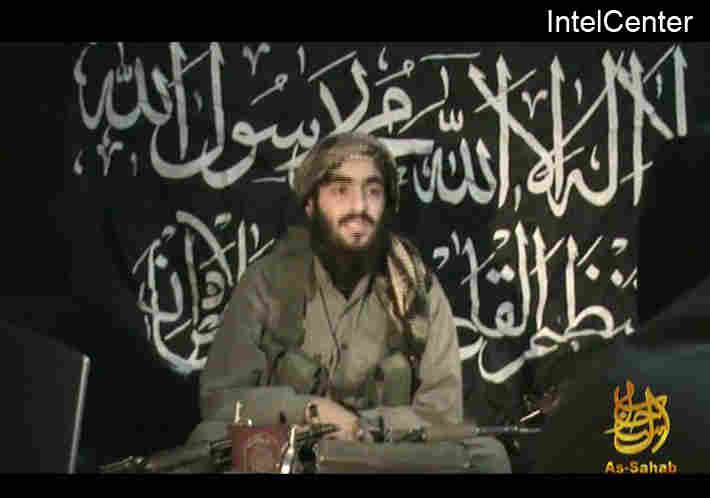 JaC: This is an extremely important question; so much of our analysis of what’s going on depends on groups like this. SITE Intel Group is obviously the current manifestation of this. Before that, there was an equally-interesting group called IntelCenter, which was another one of these Washington groups monitoring the jihadi online chatter and trying to discover new tapes, and so forth. IntelCenter was implicated in a number of – not just suspicious, but – outright fabricated so-called releases of al-Qaeda material. They would claim to have found online, in some obscure jihadi forum, this new al-Qaeda propaganda video, and they’d release it. And it was a paid subscription service; news services would pay expensive subscriptions to this service in order to get access to these new tapes as they were released. The interesting thing is – although I don’t have the details in front of me – there was one supposedly brand-new al-Qaeda video released by the IntelCenter, that researchers found contained footage that was actually contained in a docudrama – (by the BBC, I think) – that had aired a year earlier. Such crazy shenanigans went on with the IntelCenter, and my understanding is that the group was discredited because it became well-known that it was forging, faking and putting together old footage and releasing it as new al-Qaeda releases in order to continue getting subscribers to pay through their noses for this service. So at the very least there’s a monetary incentive for groups like this one to hype up a threat that isn’t there; but of course, there are also more nefarious purposes, and those come in with a group like SITE Intel Group.
JuC: I was concerned by a video I saw on the SITE Intel Group blog of a guy called Abu Khalid al-Australia – a most implausible name. There he was in front of a whole group of ISIS fighters speaking to the camera and delivering a warning to the whole world, and he was saying:
“These weapons we have, these soldiers, we will not stop fighting, we will not put down our weapons until we reach your lands, until we take the head off every tyrant, and until the black flag is flying high in every, single land, until we put the black flag on top of Buckingham Palace, until we put the black flag on top of the White House, we will not stop and we will keep on fighting…”
I can’t say it’s not genuine, but there was something about it: the extreme quality of it, the fact that the guy was speaking in an accent which struck me as more British than Australian. It all looked staged to me; it had that quality to it. I can’t prove that, but you see what I mean. Everything that you’ve just said to me feeds into my suspicions.
JaC: Well, exactly. There’s not only the monetary incentive for groups like the IntelCenter before, or SITE Intel Group now, to fake these types of things in order to maintain their subscriber base, but obviously there are intelligence connections and manipulations that could go on through groups like these in order to seed legends for agents that they want to place in the field for later use. And, what recourse do we have, as the general public looking at this propaganda, to verify it in any way? It’s just…
JuC: Trust.
JaC: Exactly. Often it’s just videos that are reported on; we often don’t even get to see them. We’re just helpless people in this propaganda Matrix if we simply accept what is being told to us. We have to be at least sceptical of what’s being told to us. Unless or until some sort of proof is provided of some of these characters and the things that are being paraded in front of us, how on earth can we simply trust everything that is being said?
JuC: Yes. Regarding this Abu Omar al-Baghdadi, I have here in front of me a quote, again from that 2007 article, saying that the US military back in 2007 had said that Abu Omar al-Baghdadi doesn’t even exist. This is the quote:
“Brigadier General Kevin Bergner told a news conference that Abu Omar al-Baghdadi, leader of the self-styled Islamic State of Iraq, which was purportedly set up last year, did not exist.”
JaC: Yes, and even more confusing because eventually it became the official position of the US Government that he did exist, and they did kill him. But there was confusion over that, supposedly because recordings were being released of this person claiming to be someone calling himself al-Baghdadi – “The Baghdadi” – again, clearly a nom de guerre, a fake jihadi name. (They adopt ridiculous names like “Al-Australia”, or “Al-Converti” apparently in Canada, in order to show various allegiances.) The suggestion was that this was primarily a foreign-funded and foreign-based group that was attempting to make itself look more authentically Iraqi. So that’s why there were two Baghdadis leading it (“The Baghdadis”, i.e. people claiming some sort of affiliation with Baghdad and Iraq) who were trying to make it look like a local indigenous group, when in fact they were really foreign transplants. That feeds into the entire propaganda narrative of this group in that middle part of this last decade. That’s presumably the basis behind even the US Government questioning the existence of Baghdadi at that time in 2007. But, as I say, by the time he was killed in 2010, presumably he was a real person, or they believed him to be. It’s all just faces, and names being paraded in front of our eyes. There’s very little we can do to verify any of what’s being told to us about this, other than to listen to the tapes and parse what’s going on. We have no access to any of this material in a way that would make it verifiable for anyone but dedicated groups that were on the ground trying to source this information. Unfortunately, when it comes to those groups, they all tend to be people with axes to grind, quite obviously. For example, the SITE Intel Group was founded by Rita Katz in Washington, D.C., who is from an Iraqi Jewish family, born in southern Iraq in 1963. She spent some time in Israel where she served in the Israeli Defence Forces, a committed Zionist who said that she believes the Jews belong in Israel, and thing like that. Clearly, that means there is a political nature to the work that she’s doing. We have to be aware of these biases. And, from a more conspiratorial angle, [we must be aware that] things can simply be created by groups like these just putting things on their website that we have absolutely no way to verify.
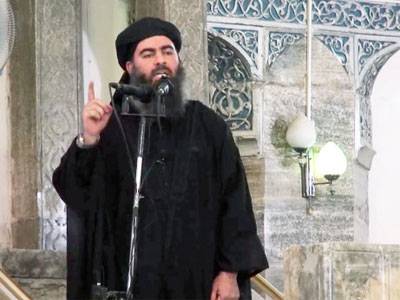 JuC: The last guy in this list of names and faces we have no way of verifying is this Caliph of the Islamic State, Abu Bakr al-Baghdadi, whose full name is Ibrahim ibn Awwad ibn Ibrahim ibn Ali ibn Muhammad al-Badri al-Samarrai. Have I got that right?
JaC: I hope so. [laughs]
JuC: You’ve said that we pretty much know zero about that person. Is that right?
JaC: Well, to clarify, there is a biography online that I understand has been sourced from some sort of Islamic extremist forum, which has been translated, I believe, by the SITE Intel Group. (I’m not sure if they translated it, but I believe they’re hosting it.) At any rate, that biography is online and claims various things about the background of “Caliph Ibrahim,” as he’s styling himself these days. But there’s absolutely zero in terms of any documentation on this. There are some scattered reports; the BBC, for example, cites unnamed, unverified, uncheckable reports.
JuC: “Sources say…”
JaC: Yes, “sources say” that he was at a university at the time of the Iraqi invasion and things of that nature, but almost zero – I mean absolutely none of it is in any way verifiable. Again, we are being asked simply to take this at face value. I tend to think that really nothing is known of this person, until the point at which he was apparently apprehended in Iraq and held at a US camp in Iraq. But again, there are conflicting reports of that. He was held as a civilian detainee by US forces at Camp Bucca. This was during the American invasion. So the official story that the American Government is floating at this time is that he was detained from February until December of 2004. But the former commander of that camp, Army Colonel Kenneth King, absolutely insists that this person – whatever his name may be, Abu Baqr al-Baghdadi we’ll call him – was there at the camp until 2009 when the camp was turned over to the Iraqi forces. He insists this in the face of being told: “No, the US Government claims he was released in December of 2004.” He continued to insist: “No, I specifically remember him.” This relates to a story that he tells of Al Baghdadi apparently saying – at some point during his tenure, presumably after 2004 – something along the lines of, “I’ll see you in New York.” It’s obviously meant to be an ominous statement about the future intentions of this leader of the Islamic State. So again, there are conflicting reports. We don’t really have any information about whether or not he stayed on, or what happened when he was transferred to the Iraqi justice system after Camp Bucca was handed over. Obviously he was released at some point and become the leader of ISI in May of 2010. So, sometime between 2009 and 2010 he must have been released, if he hadn’t been released before, but almost nothing is known. In fact I’ve read that there are only two photographs of him in existence…
JuC: That’s right.
JaC: I’ve only seen one of them, which is linked on his Wikipedia article if you’d like to check…
JuC: I think I have seen a second one…
JaC: Well, the second one that I’ve seen was from a video that was released shortly after it was claimed that he was dead earlier this year. There was a video released of him delivering a sermon in Mosul that was meant to quash the rumour that he was dead. And he looks vastly different, with a long, flowing beard, and obviously looking quite different than he did as a detainee. But interestingly, if you look at his mug shot from his time as a detainee at Camp Bucca, I think it looks very similar to the picture that has floated around on the Internet for over a year, I believe, of John McCain meeting with Syrian militants when he did his little surprise trip to Syria, either last year or the year before. If you look at those photos, you can see someone who looks very much like the mug shot of Al Baghdadi at Camp Bucca. This, of course, has been officially denied by the McCain team, but it is an interesting possibility that he might have been there in the vicinity of the leader of the Islamic State of Iraq before it became the ominous organisation that we’re supposed to fear.
 JuC: The plot thickens, indeed. Another dimension to the whole tale is where ISIS seems to be getting equipment and money from. When I turn to the BBC—which of course I do in the spirit of Orwell’s words: “I heard it on the BBC, so I know it must be true”—on their page “What is Islamic State?”, which is one of their “Editor’s Choice” articles, I’m told that they have:
“…a wide variety of small arms and heavy weapons: truck-mounted machine guns, rocket launchers, anti-aircraft guns, portable surface-to-air missile systems, tanks, armored vehicles, Humvees, and bomb-proof trucks.”
The only indication as to where some of this equipment might have come from, at least on that page, is that it may have come from the Iraqi and Syrian armies. And, regarding finances, they say that ISIS is reported to have 2 billion dollars (or 1.2 billion pounds) in cash and assets, making it the world’s wealthiest militant group. They do mention that initially much of the finance came from individuals in Arab Gulf States, but all they say beyond that is that ISIS is now a…
“Largely self-financed organisation, earning millions of dollars a month from oil and gas fields that it controls, as well as from taxation, tolls, smuggling, extortion, kidnapping. The offensive in Iraq has also been lucrative, giving it access to cash held in major banks in cities and towns it has seized.”
So, [the impression given] seems to be: initially ISIS was supported by various Gulf State individuals, but since then most of its money and equipment has come from pure conquest. So, James, do you think that’s a satisfactory picture that’s being painted there?
JaC: Well, I would say it’s an incomplete picture. I think we can fill that picture in with some interesting, seemingly independent, reporting coming from unlikely places, including thedailybeast.com, which for some reason has been reporting on a lot of these types of stories, including one that I picked up on and tweeted recently: “US Humanitarian Aid Going to ISIS”. This just talks about the way that, for example…
“US warplanes strike at the militants of the so-called Islamic State in both Syria and Iraq, but while they do so, truckloads of US and Western aid have been flowing into territory controlled by the jihadists, assisting them to build their terror-inspiring caliphate. The aid, mainly food and medical equipment, is meant for Syrians displaced from their hometowns, and for hungry civilians. It’s funded by the US Agency for International Development, European donors, and the United Nations, but it is ending up in the hands of the Islamic State militants.”
So, there’s an ongoing narrative that these aid groups are doing their best, and they’re trying to deliver it, but it keeps getting hijacked – things of that nature. There are also admissions that in order to enter some of these areas, people have to pay tolls, which are basically bribes, in order to get this aid. This is presumably a type of extortion which is being used to fund some of these activities. There’s even the suggestion that some ISIS militants are literally on the payroll of some of these aid organisations. There’s a quote from an aid coordinator who says:
“There’s always at least one ISIS person on the payroll. They force people on us and when a convoy is being prepared, the negotiations go through them about whether the convoy can proceed.”
It’s a very bizarre relationship. I suppose we could imagine a situation in which all of this is a very real conflict, and in order to get emergency supplies and humanitarian aid to people who really do need it, you would have to co-operate in some way with the people who have some degree of military control over the area. But I am highly suspicious of reports like these, because it comes down to what are the actual capabilities of this group, and how many people are fighting for it, and to what extent they are able to maintain control over this vast stretch of land. To what extent, for example, are they able militarily to control every convoy that’s going through the area? It seems beyond their capabilities. The stories, for example, of raiding the Mosul central bank and getting 429 million dollars (or thereabouts) is, again, highly dubious to me. There are certain revenue sources that I suppose would be commandeerable by a group like this, such as access to the oil fields in northern Iraq, which the Kurds have been using to try to fund their fledgling state, until now. A lot of those sites have been taken over by this group, so we can imagine these as sources of funding. But I think there has to be more to it, and I think that the big missing piece of that puzzle is, as you alluded to, the sponsorship of the Gulf States.
JuC: Yes.
 JaC: The idea has been put forward that the aid, supplies and training sent to Syria in the last few years have been for funding the so-called “moderate rebels”, [but] I think that’s a completely ridiculous distinction that never really existed. I think it’s been known for some time that, even if there were supposedly good intentions behind these deliveries, all these arms, aid and money were ending up in the hands of the most extreme groups anyway.
JuC: Absolutely.
JaC: So, at a certain point I think there’s no one that can claim plausible deniability when it comes to knowingly funding the most extreme groups, including of course the ISI.
JuC: Well, around that time I was amazed when then-Foreign Secretary William Hague was saying things like: “Oh yes, I think it’s possible to keep that kind of assistance out of the hands of Al Nusra.” How on earth are you going to that? It seems ridiculous. Do you think there’s a case for saying that some of the Libyan assistance is ending up in the hands of IS, as well?
JaC: There certainly is; we have that from multiple, different perspectives. For example, Lieutenant Colonel Anthony Shaffer, who people might remember as the person who blew the whistle on the “Able Danger” programme (if they’re familiar with that in regards to 9/11) – he has talked about it. [So have], whistleblowers James and JoAnne Moriarty, who I’ve had on my programme; they were doing business in Libya at that time. There was [also] another person who was affiliated with the CIA. At any rate, there have been three different sources that have talked about the way that the weapons that were being plundered from the fallen Libyan Government were being shipped through Benghazi, ultimately to Syria by way of Turkey and Jordan. So, there is a line that can be drawn, and according to this narrative that’s what the Benghazi events of 2012 were all about. It was about the ambassador at the time in Benghazi basically refusing to go along with it anymore. He was threatening to blow the whistle, and so he was disposed of; that is the alternative version of what happened in Benghazi. So, absolutely, there certainly is a line that has been drawn by multiple sources between Libyan arms and Syrian groups.
JuC: In your interview with James and JoAnne Moriarty, they talked about this Benghazi bank, and said that it was set up with a billion dollars of Saudi money in order to pay mercenaries. And they talked about a quarter of a million mercenaries being employed to help unseat Qaddafi; and I’m thinking: What’s happened to those quarter of a million mercenaries?
JaC: It’s a valid question. I think one of the obvious places for that mercenary force to be dispatched, if it were to be kept together, would be Syria. So, I think the obvious implication is – maybe not ¼ million, but – at least some significant percentage thereof has basically shifted field of operations. It is an interesting feature of a lot of these ISIS fighters that they generally appear with covered faces, or are photographed in such a way that it’s not immediately apparent who they are. I think this relates to the fact that a lot of them are not indigenous to the area. In fact, a lot of them are Chechens, and it’s on the record that Chechen generals and others have taken front and centre in the ISIS ranks. So this is by no means an indigenous group fighting for the well-being of the area. At the lower levels it’s all about religious sectarianism; at the higher levels it’s about intelligence manipulation in the region generally.
JuC: Well, talking about intelligence manipulation, when I last spoke to Dr. Stanley Monteith he said something like: “If you want to know who created ISIS, then just type ISIS and CIA into your favourite search engine, and you’ll find out what you need to know.” Obviously, he was painting with a broad brush there, but I’m guessing he was thinking of this operation centre in Jordan, with connections linking the CIA, UK, France and Prince Bandar of Saudi Arabia. Could you tell us a little about that operation centre, if you think that’s relevant to this ISIS question?
JaC: Absolutely, I believe it is very relevant. In late-2011, boilingfrogspost.com, the website of FBI whistleblower Sibel Edmonds, was the first to report on a secret US/NATO support and training camp to oust Assad, that was stationed in Jordan. This report was sourced from a whistleblower that Sibel was in touch with, who I then interviewed in December 2011. (It’s available on YouTube under the title: “Breaking: US Troops Deploying on Jordan-Syrian Border”.) This whistleblower, a Syrian journalist named Nizar Nayouf, talked about the base in Jordan, in the north-Jordan city of Al-Mafraq. The reports at that time were indicating that a Jordanian military officer, who asked to remain anonymous, had seen hundreds of soldiers at the base speaking languages other than Arabic and being accompanied by American forces. This was a pretty significant development at that time. I was, of course, almost completely ignored by the mainstream media. One source that did pick up on it, and report on it was WND (which is not necessarily a reputable site for a lot of reasons), but they did pick up on this story and report it in February of 2012. It was eventually reported by The Guardian, I believe in 2013, so by March 2013 it had become mainstream knowledge. There was also a Democracy Now! report on this subject which I believe related back to a Washington Post report (I think) that talked in more detail about this base. [It mentioned] the co-operation of a number of different countries, but most prominently its coordination by the CIA. Basically this was a training camp being used to train forces to send into Syria, presumably to topple Assad. And it turns out, lo and behold, that some of the people they were training became members of ISIS. The way that was reported is interesting in itself. For example, WND picked it up under the headline “Blowback”, and then the headline changed. I can’t remember what it originally read; it now reads: “US Trained Islamists Who Joined ISIS.” I believe it read something more along the lines of “US Trained ISIS Fighters in Jordan,” or something like that. They’ve now rephrased that because they’ve added an Editor’s note: “Since publication, this story has been corrected to clarify that the fighters trained in Jordan became members of the ISIS after their training.”
JuC: Right.
JaC: So, the implication is that the US didn’t know that these fighters were radicals, or that they were going to be radicals, because they couldn’t predict the future. These people became radicals after they were trained.
JuC: Same story again – yes indeed.
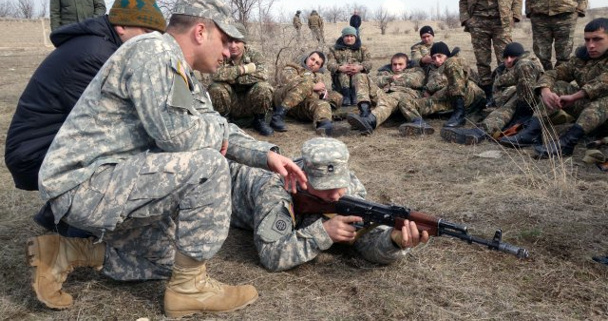 JaC: That gives arm’s length, plausible deniability to that story. But it’s ridiculous to think that these types of people, who are being trained specifically to go in and overthrow a foreign government and then be let loose, are not going to be involved in groups that would engage in these types of activities. So I think it’s plausible deniability. I think the preponderance of history alone is on the side of this not being some sort of unforeseeable blowback, like: “Whoa, wouldn’t you know it? It just got out of our hands.” I think there has to be intelligence agency complicity in this.
JuC: This brings me to the question as to who, or what, are the real driving forces behind ISIS? I guess we could just settle for the general presentation by the mainstream that this is a spontaneous grouping of ultra-violent jihadists. But, as I’ve said before, given the lies that swirl around the War on Terror – and war in general – I think we are justified in looking around more broadly for possible vested interests in all this. In your podcast on ISIS, you drew attention to three factors that we might consider. I know you have more in mind as well, but the ones that you mentioned were the Iran-Iraq-Syria gas pipeline, the Greater Israel doctrine, and Gladio B. I won’t ask you to give us all that in one go, so would you mind starting with the Islamic pipeline? How might that fit into the picture?
JaC: Well, the so-called Islamic pipeline was intended to connect Iran’s South Pars gas reserves to Syria ultimately via Iraq; so it was an Iran-Iraq-Syria pipeline. A memorandum of understanding for a deal connecting those countries via pipeline was signed in July of 2011, and the idea was that the South Pars gas fields – the largest gas fields on the planet, I believe – were going to supply the pipeline that would then run all the way up to the city of Homs, and then be shipped out through a Syrian port directly to Europe. That would bypass the Russian gas and Gazprom, which one would presume in the current political climate would be something that Europe would be very eager to do. (As for sourcing from Iran’s South Pars gas fields, perhaps there are other political concerns when it comes to this.) Whatever the case may be, in July of 2011 a memorandum of understanding was signed, and this was just at the time that Al Assad’s government was starting to be undermined. And, lo and behold, now we have the Islamic State occupying, or claiming to occupy, the very area where this pipeline was eventually going to end up. So, I think, we at least have to look at who would benefit from the disruption of the pipeline. And one of the obvious players would be Turkey, which would have been cut out as the middle-man for supplying Gulf gas to Europe had this deal gone ahead. So, Turkey has to be seen as one of the players with an interest in seeing the disruption of the pipeline, and the fostering of extremist groups to that end. And, of course, it has not gone ahead; that should be stressed. The deal has been put on hold, let’s say, and no further work on the pipeline infrastructure has proceeded, to my knowledge, since that memorandum of understanding was signed three years ago.
JuC: And Qatar fits into the picture too, doesn’t it?
JaC: It certainly does. There’s not only the gas-and-energy side to this, there’s [also] a regional shift going on right now. A power vacuum has existed for at least a decade since Iraq was overthrown. That completely upset the balance of power in the region, and into that power vacuum a number of different states are vying for at least increased regional dominance, if not total regional dominance. Really, if it wasn’t for Iraq, Iran would be the dominant regional power; except for the fact that Iran has been completely marginalized through sanctions, and now through the destabilization of one of their key partners in the region, Syria. Interestingly enough, when you look at the so-called Shia Crescent, which extends from Iran through Iraq to Syria, much of it is now controlled by the Islamic State, a Sunni group. So, interestingly, that seems to undermine any hope of Iran being a regional power-player. Thus we see countries like Turkey, Qatar and Saudi Arabia, I think, all trying to step into that power vacuum in order to become greater regional players. So, we see a relatively small nation like Qatar, in recent years, trying to take more of a lead role in some of these operations, like co-ordinating the Friends of Syria group and things of that nature; and the Arab League and other such organisations trying to step up as some sort of power player or deal-maker in the region. I think that would be another type of incentive that some of these countries might have in seeing the destabilization of Syria.
JuC: And there’s another factor that you say we should at least consider – which might well be interested in various power vacuums in the area – and that would be Greater Israel. I believe the Greater Israel doctrine goes back to the turn of the 20th century. Do we have reason to believe that this is still operative in some way?
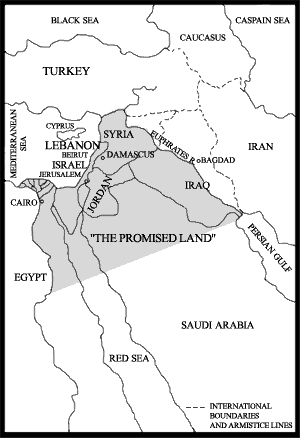 JaC: Well, let’s put it this way: We have no reason to believe that it is not still operative. It’s obviously a long-term strategy that has been held by certain elements of the Zionist faction in Israel, and explicitly stated since the early part of the 20th century. We can trace it back through the Oded Yinon Plan, which back in 1982 talked quite explicitly about the breakup of Iraq and Syria, amongst other nations, along sectarian lines. A quote from that document reads: “Lebanon’s total dissolution into five provinces serves as a precedent for the entire Arab world, including Egypt, Syria, Iraq, and the Arabian Peninsula, and is already following that track.” So, I think this is part of a long-term strategy that quite obviously plays into the geopolitical interests of Israel in trying to keep the region around it divided and thinking more in terms of religious sectarian differences than trying to come after Israel. So, there is, I think, quite an obvious geopolitical benefit to that. But when we look at some of the suggestions about direct Israeli involvement, I think some of them are completely spurious. One that I’d like to address is the idea floated on-line that the current leader, Al Baghdadi, was actually an Israeli Mossad agent. This was claimed to have been revealed in documents released by Edward Snowden. This entire story is 100% fabricated; there were never any such documents by Snowden. (I can’t remember where that story originated, but there’s a link in the show notes for my podcast.) If you follow the story back, it was completely made up and then repeatedly reported ad nauseam in the alternative media, which very quickly grabbed onto it without ever once trying to locate any of these supposed documents that supposedly revealed this supposed connection. So, it’s certainly a warning, and we need that from time to time: Just because propaganda and lies come out of the mainstream media, that doesn’t mean that we can just turn off our critical faculties when it comes to the alternative media…
JuC: Absolutely.
JaC: … in which such propaganda, lies, deceits and misinformation can be propagated just as easily.
JuC: Yes. You also mentioned Gladio B in your podcast, and you’ve had fascinating conversations with Sibel Edmonds on that subject. Now, I’m sure that Operation Gladio is well-known to most people listening to this interview, but perhaps not so-called Gladio B. Whereas, as far as I understand it, Gladio was essentially a Cold-War, mainly Western-Europe, operation, Gladio B represents a shift to global operations, with a particular emphasis in Central Asia and the Caucasus.
Now, I know this is a huge question, but could you briefly give us an idea of Gladio B, and how perhaps it fits with what’s going on with ISIS, if there’s any link at all there?
JaC: Absolutely, [but] let me give a little background to Gladio. Gladio was the name for the Italian (and perhaps most famous) part of the NATO stay-behind operation. In other countries it was called different things; so, in Belgium it had a different name, and so on. But I think it is important to stress, that, according to Sibel Edmonds, one of the central places where that operation was taking place was always Turkey. And Turkey is very interesting from a geo-strategic point of view on the Grand Chessboard. It certainly does provide a window onto the Central Asian-Caucasus region, and has its own interesting history and part to play in the creation and fostering of radical, extremist Muslim groups.
Gladio (as we’ll call it for the sake of convenience) was a military operation that was focused on using ultra–nationalists and groups of that sort in order to create a strategy of tension in order to demonize political opposition or achieve various political aims.
Gladio B was the transition from that use of ultra-nationalist groups towards the use of Islamic extremist groups. Around 1996 there was an interesting scandal in Turkey called the Susurluk Scandal. A terrorist was discovered to have died in a car crash, along with the Turkish Chief of Police (as I recall) and some other high-ranking Turkish officials. This was a very interesting scenario, and it exposed some of the deep-state connections going on in Turkey. And it was around that time – according to Sibel and the investigation that she was part of as a translator in the Washington Field Office of the FBI – that this operation started to transition into using specifically Islamic terrorist groups to foment a strategy of tension. I think the scope is global, but there is specific targeting of the Central Asia/Caucusus region, because it is increasingly important in the post-Cold War age. Russia, China, the US, NATO and all of these players are scrambling for different pieces of the Chessboard, and the Central Asia/Caucusus region is extremely important in geo-strategic terms; it’s also right on the doorstep of Russia and China.
So, we see, for example, the funding of people like Imam Fethullah Gulen. He was run out of Turkey and ended up in Pennsylvania, of all places, where he was sponsored on his visa to enter the United States by CIA operatives like Graham Fuller. (There’s a fascinating history behind all of that, and people can find out more in my “Eye-Opener” for boilingfrogspost.com called: “Who is Graham Fuller?”)
So, we see some of these intelligence and Pentagon connections to people like Imam Fethullah Gulen, who runs a $20-billion empire from Pennsylvania, and it includes hundreds of madrasas that have been opened up in that Central Asia/Caucasus region over the years. This ties into the fomenting and creation of these Islamic extremist groups.
I don’t have specific information connecting Gladio/NATO operations to the Iraq and Syria region. (I will be talking to Sibel Edmonds about this in the near future, so hopefully we can clarify that.) I can’t say at this point that I have any direct evidence of a connection, but it’s something that we should keep in mind. It’s very much part of the modus operandi of this operation to create and foster some of these Islamic militant groups in order to achieve geopolitical aims. I think NATO has a very big stake in what is happening in the Syria-Iraq region for a number of different reasons, including simply the maintenance of military forces in a region that they are increasingly being pushed out of in various ways. Of course, famously, American forces were supposed to leave Afghanistan in 2014, but now have a deal whereby they’re going to stay on until at least 2024. So we see an unwillingness to leave the region, which I think gives the lie to any idea that the invasion of Iraq or Afghanistan was about anything other than maintaining a military presence in a very geostrategic region. So, tying that back in, NATO, as the overall umbrella group that’s running this operation Gladio B, would be very much interested in keeping the tension going in the region, between the Sunni and the Shias. It would be an excuse for the exact type of thing which we’re seeing playing out right now—the airstrikes that are being led by the Gulf States—but obviously with the active co-operation from the US leading from behind, as they say. So, it’s not something to which I can draw a direct line at present, but it is something about which I think we should be aware, simply to have a greater understanding of the ways that these types of groups are funded and manipulated from behind the scenes by this organisation, which is sometimes referred to in the intelligence context, but which I think would more accurately be seen as a military operation being spearheaded by primarily NATO and the Pentagon.
JuC: So, if Gladio is operative with respect to ISIS in some kind of way, would that imply that this is a quasi-NATO operation to some extent? (I’m putting the word quasi in there because Gladio A – as I’m calling it – was unknown to the vast majority of those in authority in NATO countries back in the ’60s, ’70s and ’80s.) So, would that mean that Gladio B, if it’s operative, would also be something secret with respect to most people in authority today, so they wouldn’t really know what was going on at that level?
JaC: We would have to assume that to be the case. Operation Gladio had gone on for decades. Although traces of it had leaked out earlier, it was finally exposed by the Italian Prime Minster in 1990. At that time it became apparent even to Prime Ministers of some of these countries that they had not been informed of these operations. So I suppose you could say this is a type of shadow government infrastructure that operates behind the scenes, transcending any particular government that can be voted in or out. Neither is it necessarily beholden to any of them; those governments are not necessarily even aware of the existence of these operations. So, I think we should presume that to be the case with future intelligence operations; so with Gladio B, there would be governments that would have no idea that these operations were going on. It’s about compartmentalisation, black budgets, and the secrecy infrastructure of the intelligence agencies that were set up in the wake of the Second World War. That enabled this type of operation to proceed without necessarily the explicit approval, or even awareness, of the so-called highest offices in the land.
JuC: I said to you before the interview that I didn’t really want to talk about this, but I feel we should. What is your view of these beheading videos that have been coming out? I admit that this is not something that I’ve looked into very much, but I do find myself asking “cui bono?” when I see something on the front of a newspaper. And, quite apart from all the video fakery and that kind of thing, I’ve heard a number of explanations for these beheadings, like: they’re done to inspire people to join ISIS; they’re done to outrage the US, the UK, France, etc., so as to draw the West into war, which would in turn increase hatred for the West, or bleed the West dry. And when I hear those things, I think maybe. But, on the other hand, we might think that goading the West into war against you is actually the least likely strategy. I mean, why not just get on with the business of conquering Iraq and Syria without interruption, and just get much stronger? Also, why target Western journalists (who are there to do their job) and aid workers (who are there to do good)? Isn’t that exactly what you would do if your were arranging some kind of false flag to drum up support for Western military action against ISIS? That may sound too cynical, but I can’t help but think slightly along those lines when I see these kinds of reports. What do you think of that?
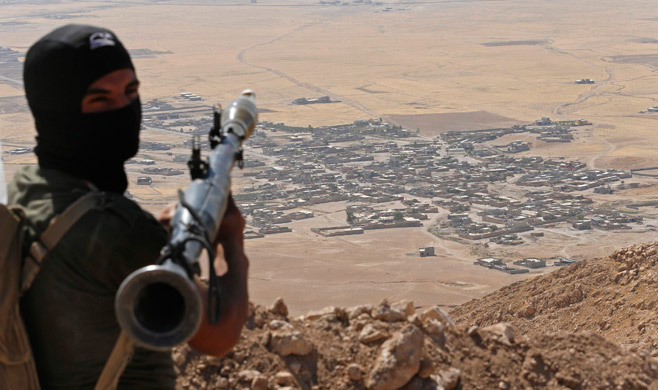 JaC: Well, I agree with your analysis. If we start at the end result of this, we certainly have the public of the Western world seeing this paraded across the news headlines and being outraged and motivated to do something. So the end result is ultimately what we have right now: air strikes proceeding that would have been unthinkable before ISIS was proclaimed as the Great Satan of the Western world, and the bogey man that needs to be attacked right away.
And, of course, this has been going on for some time. Air strikes of some sort or military operations have been proposed in Syria for the last couple of years. Just last year there was the chemical weapons attack in Ghouta that was attempted to be blamed on the Assad government that…
JuC: Yes.
JaC: … was supposedly going to be the motivation for some sort of air strike campaign in Syria that failed to come to fruition. But now we have these beheading videos. And now, of course, all of the opposition that existed to that Syrian strike last year has completely disappeared. (The opposition was was quite sizeable, and quite notable in London, New York and other places. Vast demonstrations were held against the idea, with the “Save Syria” banner being waved.) Now, however, I think the average, uncritical consumer of media headlines is generally supportive of it: we have to do something. So again, just working from the end result backwards, it is plausibly understood as a propaganda campaign designed to motivate the public into some sort of military action. Now, as to what specific threads of evidence we have for that, that’s on much shakier ground.
JuC: Sure.
JaC: To be clear, there are a lot of very suspicious things about these videos. There are even mainstream reports of various people coming out in public and saying that these videos seem staged in some way. So again, whether they’re staged or not; whether they’re real or not; and whether they serve some purpose for an authentic Islamic group, really trying to provoke and goad the Western world into some sort of action against it; the end result is that it does allow a military operation to take place, which the Western governments have been trying to convince their own populations to support for some time now.
JuC: What do you think alternative explanations such as (though I find this not very plausible): that it’s all an attempt to create hatred of the West? I mean, I thought that there was enough hatred of the West already?
JaC: Well, I see a certain logic to that, depending on what the end goal of a group is. I mean, for example, in the old al-Qaeda narrative, the idea was that Bin Laden wanted to provoke the US into action, in order to engage and deplete the resources of the Great Satan. I guess that’s a strategy: for a group that’s not a state actor, without the resources to engage the United States militarily, to draw them into a different country like Afghanistan or Iraq, and attack them there through terror operations, in order to sap their will and deplete their resources. There is some logic, I suppose, to that. I don’t necessarily believe it is a convincing explanation for the scale of what we see going on, but it depends on the aims of the groups. After all, there are people flying the Islamic State flag who really do believe in what they’re doing; not everyone is some sort of intelligence construct. There really are people who are motivated by religious hatreds and motivations here.
JuC: I agree. It could create a very false impression to think of it all in conspiratorial terms.
JaC: Consider the context of Assad in Syria, supposedly launching chemical attacks on his own population for no purpose whatsoever. From a military perspective, the Syrian Government was clearly winning at that point—why on earth would they launch chemical weapons attacks, the result of which would be to provoke the West into some sort of military action against it? It would be suicidal and ridiculous. But I think a non-state actor with ideas of global jihadi conquest idea might want to draw such groups into the area so that they could engage them directly. It’s not as if Islamic State is worried about losing any particular infrastructure, because it’s all recently conquered infrastructure. So again, I see some sort of logic to this, but I’m not particularly convinced by it.
JuC: Fair enough. Well, the whole thing is very strange, and I find it difficult to get a clear picture of what’s really going on with this, and…
JaC: It is a very bewildering tale. There are so many different threads to this story, so….
JuC: Yes, I guess the only thing that we can really say, based on previous experience, is that whatever is going on, we are certainly not getting the whole truth about any of it. Having said that, is there anything that you would like to end with that might help us to gather these strands together in some way? I mean, not to give answers, but at least to point the way forward for us in thinking about these things.
JaC: Well, let’s end up where we started, with the idea of the open-source investigation which we’ve been conducting at the Corbett Report. I want to extend this further in the coming months and years, because I think this is an important point in the development of the alternative media. I think there needs to be a way to process information that goes beyond the scattershot collection of a few links and then putting that together as some sort of analysis. I think we need something more encompassing happening, and that’s what I’m attempting to foster in my own small section of the Internet. On the large scale we’re trying to supplant completely the system that has developed: the newswire services, the giant newspapers of days past, such as The New York Times, that had the ability to employ reporters all around the world and amass a great degree of intelligence. We’re attempting to supplant that paradigm. There needs to be a way to draw information from various different sources and form it. But not necessarily to finalise it, because this is the Internet: publication does not mean we have to put something in print and commit to it and not be able to revise it. It’s fluid and it should be, but we should be able to form some sort of coherent narrative from the various sources. So, that’s something that I’m very excited about when it comes to what’s happening right now at the Corbett Report. We have listeners literally all around the world, in dozens of countries, speaking different languages, collecting information and news reports from different sources in different countries in different languages, and trying to collect and coalesce and process that information, and I’m working out how best to do that, but ultimately it’s not going to be up to me. It’s going to be up to the community at large. So, if people want to join me in that quest, they can come to corbettreport.com and contribute. Members of the Corbett Report can sign in to the website and start joining in that conversation at articles like “Who is ISIS? An open source investigation,” where we have this conversation going on, currently consisting of 76 comments from people. I think that’s the model that I want to proceed with. I think it offers the possibility that we’ll be able to supplant the news collection and delivery services of old, in a more thorough-going manner than what we have now, where it seems to be a lot of lone-wolf operations collecting interesting information, but not necessarily bringing it together, and not necessarily engaging in the types of editorial discourse that I think needs to go on. You can have lots of different sources of information, but these sources contradict and they overlap at times; there needs to be some sort of process for vetting this information and deciding what’s the best way forward. That’s not going to be up to me or any other individual; it’s going to be up to people coming together and really engaging in discourse about it. So, that’s a very long-winded answer, but that’s what I’m trying to create.
JuC: Well, it’s a great vision for all of us to work on. As I said before, it’s fascinating to speak with you, James. I’m so glad that you came on again. I think that we’ve ended up with perhaps more questions floating around than answers, but that’s fine. That’s really what you’ve just been saying: that all of these questions should be there for us to consider, and we all need to be involved in this. You have nevertheless given us a wealth of information to consider as we continue to try to understand what’s going on in this increasingly mad and disturbing world. So once again, thank you very much indeed for coming on and for sparing some of your valuable time late at night to be with us, James.
JaC: Well, thank you so much for having me on. I really do appreciate it, Julian.
JuC: It’s great to speak to you.
JaC: Bye-bye.
JuC: Bye-bye.

On OffGuardian we are running a short series on “The Questions You aren’t Supposed to Ask About ISIS”.
Question One – those Toyota trucks…
http://offguardian.org/2015/03/31/questions-you-arent-supposed-to-ask-about-isis-1-those-toyota-trucks/
🙂
any idea why USA Today is suddenly backing up Erdogan vs. Gulen?
Nov 20 they followed up on Oct. 29’s story about the Gulen movement’s influence in US politics
http://www.usatoday.com/story/news/nation/2015/11/20/lawmakers-got-suspect-turkish-campaign-cash/75982732/
WASHINGTON — A Turkish religious movement accused of illegally financing congressional travel abroad may have also provided hundreds of thousands of dollars of improper campaign donations to congressional and presidential candidates during the past several years, a USA TODAY investigation has found.
USA TODAY has identified dozens of large campaign donations attributed to people with modest incomes, or from people who had little knowledge of to whom they had given, or from people who could not be located at all. All the donors appear to have ties to a Turkish religious movement named for its founder, Fethullah Gülen. USA TODAY reported last month that the movement has secretly funded more than 200 foreign trips for members of Congress and their staff.